



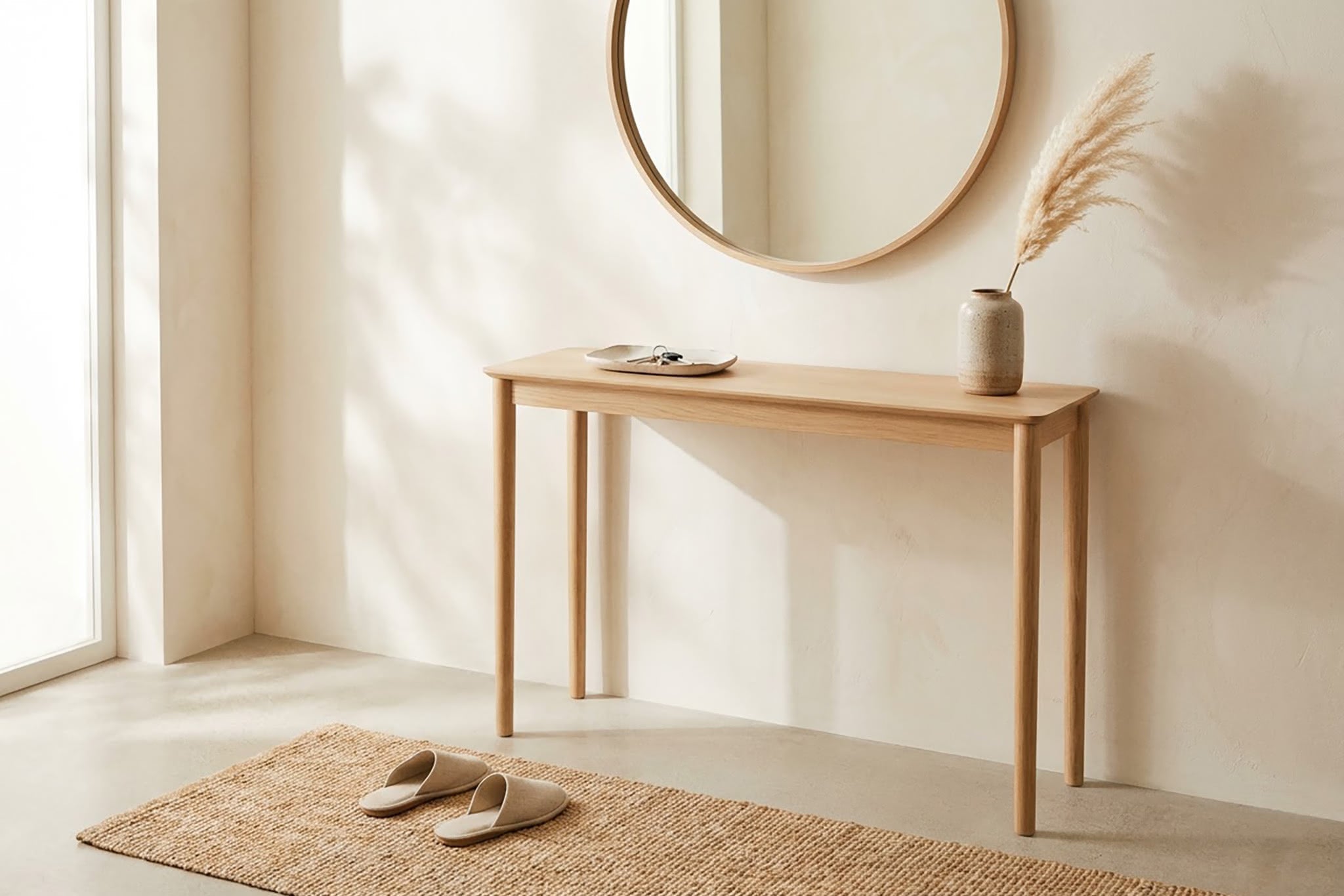
You walk through your front door dozens of times a week — and barely notice it. Your guests, though? They notice everything.
Here's the problem: most entryways end up as dumping grounds. Shoes pile up, keys land wherever, coats drape over chairs that weren't meant for coats. The space that should set the tone for your entire home becomes the one room you'd rather nobody saw.
Knowing how to style an entryway comes down to four elements — a surface, a mirror or piece of art, smart storage, and one intentional decorative detail. No renovation required, no interior designer on speed dial. Get those right and your entryway does two things at once: it works hard and it looks beautiful.
This guide walks you through each element, with specific ideas for small entryways, Japandi-inspired spaces, and everything in between.
What Actually Makes a Great Entryway?
A well-styled entryway balances function and beauty in roughly equal measure. It catches your keys, holds your bags, and still looks intentional when someone steps through the door for the first time. Interior designers often call it "the handshake of your home" — and according to a 2024 survey by the National Association of Realtors, 74% of estate agents said a well-styled entryway positively influenced buyers' perception of the entire property.
The formula is straightforward. You need:
- A surface — a console table, floating shelf, or narrow bench
- A vertical element — a mirror or piece of wall art
- Storage — hooks, a tray, a basket, or closed shoe storage
- One decorative detail — a vase, a candle, a sculptural object
That's four categories, not four objects. Some items pull double duty — a beautiful ceramic bowl stores your keys and adds character. A mirror reflects light and gives you a last-minute check before you leave.
How Do You Choose the Right Console Table?
The console table is the anchor of most entryways. It gives you a landing zone for daily essentials and a stage for everything decorative — but only if the proportions are right.
Measure your wall first. The table should sit at roughly two-thirds the width of the wall behind it. Any wider and it crowds the space; any narrower and it looks lost. Depth matters even more in tight hallways — look for tables between 20 and 30 centimetres deep. Anything beyond 35 centimetres starts eating into your walkway.
Styling the surface
The triangle rule is your friend here. Arrange objects in groups of three at varying heights — a tall element (lamp or vase), a medium element (a framed photo or small plant), and a low element (a tray or stack of books). This creates visual movement without clutter. As a general guideline, fill roughly one-third to two-thirds of the surface. Leave breathing room — that empty space is doing design work too.
If you're after a Japandi look, lean into natural materials: an oak or walnut console with clean lines, a stoneware vase, a linen runner. Japandi entryway ideas tend to work beautifully because the philosophy — fewer, better pieces chosen with intention — is exactly what a small, functional space demands.
No room for a console? A floating shelf at hip height gives you the same landing zone in a fraction of the footprint. Mount it 85–90 centimetres from the floor and you've got a surface that works just as hard.
Mirror or Wall Art — Which Belongs in Your Entryway?
Both work. A mirror is the practical choice — it bounces natural light deeper into the hallway and gives you that final glance before heading out. A piece of wall art is the personality choice — it tells visitors something about you before they've taken three steps into your home.
For narrow or dimly lit entryways, a mirror nearly always wins. A round mirror above a rectangular console creates a pleasing contrast of shapes. Go bigger than you think — an oversized mirror in a small entryway doesn't shrink the space; it doubles it visually. For a softer, more contemporary feel, look for mirrors with curved or organic silhouettes in warm wood or brass-toned frames — shapes that echo the rounded furniture lines that have dominated design fairs like Maison&Objet and Salone del Mobile since 2024.
If you go the art route, choose something with enough scale to hold its own above the console — the bottom edge should sit roughly 15–20 centimetres above the surface. A gallery wall works too, but in an entryway, a single statement piece tends to read as more intentional. For more on choosing and hanging the right piece, see our guide to wall art ideas for every room.
| Element | Best for small entryways | Best for large entryways |
|---|---|---|
| Surface | Floating shelf (20 cm deep) | Console table (25–30 cm deep) |
| Vertical focal point | Oversized round mirror | Statement wall art or gallery wall |
| Storage | Wall hooks + key tray | Slim shoe cabinet + woven basket |
| Decorative detail | Single stem in a slim vase | Sculptural vase + stacked books |
| Lighting | Table lamp on shelf | Overhead pendant (warm 2700K) |
How Do You Add Storage Without the Clutter?
Storage is where most entryways fall apart. The goal is to contain the daily chaos — keys, sunglasses, post, dog leads — without turning the space into a utility room. A few things that work well:
- A key tray or small ceramic dish on the console surface. It corrals the small stuff and stops it migrating across the table.
- Wall-mounted coat hooks instead of a standing rack. Three to five hooks, mounted at the same height, look deliberate rather than afterthought-ish. Choose hooks in a material that matches your console hardware — brass with brass, matte black with matte black.
- A slim shoe cabinet with a tip-down front if shoes are your biggest offender. These are typically only 17–20 centimetres deep and hold six to nine pairs while keeping the floor clear.
- A woven basket tucked under the console for scarves, reusable bags, or anything that doesn't have a permanent home elsewhere.
The golden rule: if you can see it, it should look good. If it doesn't look good, it should be hidden. That simple filter sorts out 90% of entryway clutter decisions.
One thing that often gets overlooked: lighting. A small overhead pendant or a table lamp on the console changes the entire feel of an entryway, especially in hallways with no natural light. A warm-toned bulb (2700K) makes the space feel inviting rather than clinical — it's the difference between walking into a home and walking into a corridor.
What If Your Entryway Is Tiny?
Small entryways are actually easier to style than large ones — every piece has to earn its spot, which forces you to be intentional. When square footage is limited, think vertically. A tall, narrow mirror draws the eye upward and creates the illusion of more space. Wall-mounted hooks and a floating shelf replace the console table entirely.
A small rug or runner grounds the space and signals "this is its own room" even if it's technically just a stretch of hallway. Choose something durable and easy to clean — jute, flat-weave cotton, or a washable wool blend. Keep dimensions tight: a 60×90 centimetre rug is usually enough to define the zone without tripping anyone.
One decorative detail is all you need. A single stem in a slim vase on the shelf. A small framed print propped against the wall. A candle that greets you with a familiar scent when you walk in. That welcome scent — cedar, linen, fig — is one of the most underrated entryway details. It costs almost nothing and makes a disproportionate impact on how a space feels.
The One Detail That Makes It Feel Finished
Once the functional pieces are in place, most people stop. The console is there, the mirror is hung, the hooks are up. And it still feels like something's missing. That missing thing is usually a single decorative object — something that exists purely to look and feel beautiful. A sculptural vase. A piece of dried eucalyptus. A handmade ceramic. A small stack of books you actually want people to notice.
This is where styling decorative objects becomes genuinely useful. The principle is the same as on a coffee table or shelf: choose one object that has texture, form, or warmth — and then resist the urge to add five more. In an entryway, restraint reads as confidence. Three to five objects total on a console surface is the sweet spot; beyond that, you're back to clutter.
Consider seasonal rotation — swap the dried stems for fresh greenery in spring, swap the candle scent, change out a small print. It keeps the space feeling alive without requiring you to rethink the entire setup. Small changes, done deliberately, have far more impact than a full restyle.
Pull It All Together
Your entryway doesn't need to be large, expensive, or architecturally interesting. It needs four things working together: a surface, a vertical focal point, storage for daily essentials, and one decorative detail that makes you smile when you walk through the door. Start with what you have, edit ruthlessly, and leave enough space for the room to breathe.
Want to keep going? Our guide to living room decor ideas picks up right where your entryway leaves off — same principles, bigger canvas.
And when you're ready to find the right pieces, browse our entryway-ready decor — hand-selected to make that first impression count.


