



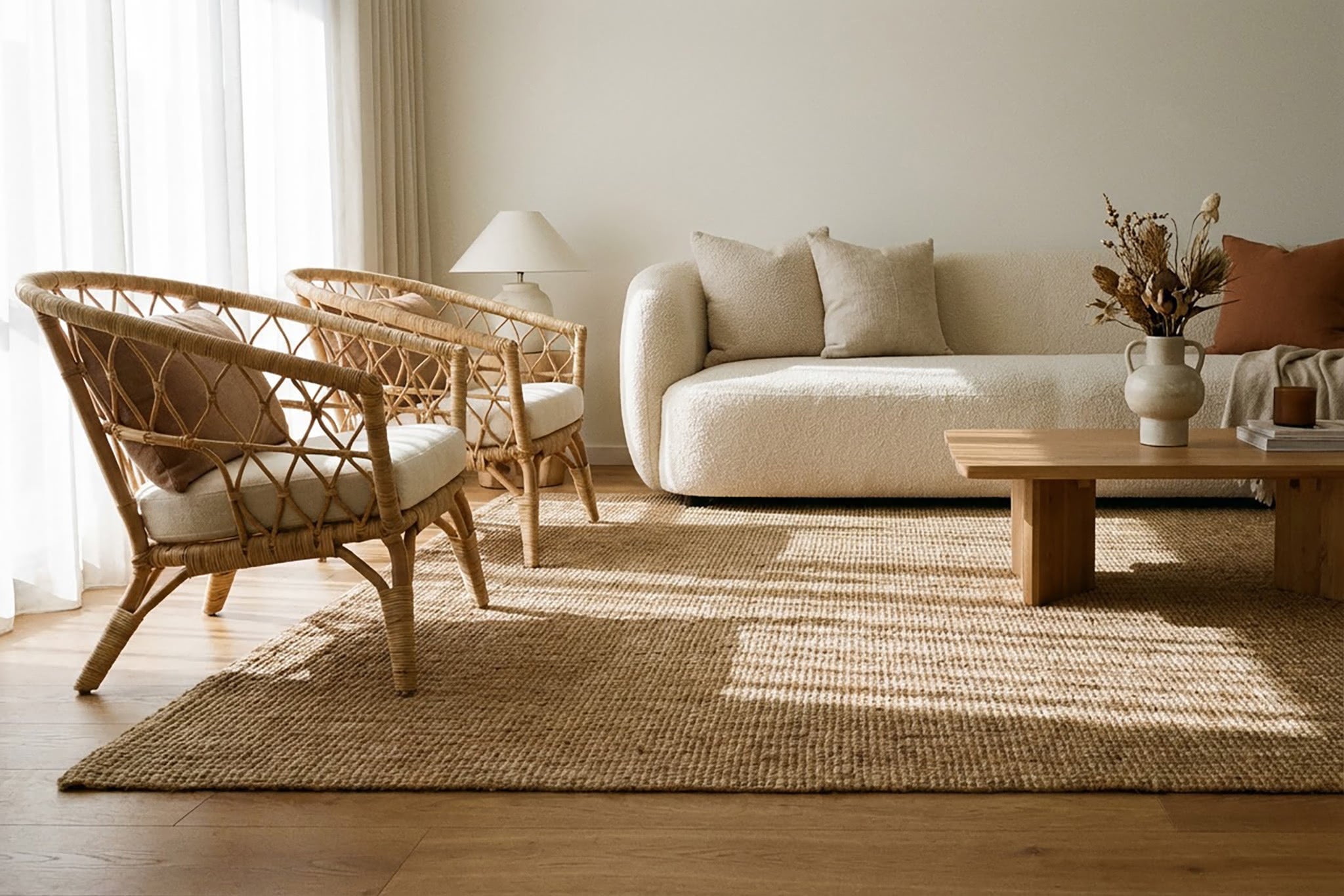
That brand-new rug you just unrolled looks like a postage stamp in the middle of your living room. Sound familiar?
It's the most common decorating misstep — and it's not your fault. Rugs are expensive, so the instinct is to go smaller to save money. But a too-small rug doesn't anchor anything. It floats in the middle of the floor, your furniture sits awkwardly around it, and the whole room feels disconnected.
The fix is surprisingly simple: know the right size before you buy. Not a rough guess — the actual measurements for your room and furniture arrangement. That's what this guide gives you. Room by room, with the exact numbers so you can measure once and order with confidence.
Why Rug Size Matters More Than Pattern or Colour
A rug's job isn't just to look pretty on the floor. It defines the seating area, anchors your furniture into a cohesive group, and gives the room a sense of proportion. Get the size right and even an inexpensive rug will make a room feel intentional. Get it wrong and even a handwoven Persian won't save you.
Interior designers at firms like Emily Henderson Design and Studio McGee agree on this point: size is the single most impactful rug decision you'll make. Colour and pattern are personal preference — size is structural. A rug that's too small shrinks the perceived size of the room, pulls furniture arrangements apart, and leaves awkward strips of bare floor that break the visual flow. According to a 2024 Houzz survey, "wrong size" was the number-one reason homeowners returned area rugs — ahead of colour mismatch, texture, and quality concerns.
How Do You Choose a Rug Size for a Living Room?
The living room is where rug sizing mistakes show up most. The golden rule: at least the front legs of all major seating — sofa, armchairs, accent chairs — should sit on the rug. This connects the furniture into one group and makes the space feel grounded rather than scattered.
Standard living room rug sizes
| Room size | Recommended rug size | Placement note |
|---|---|---|
| Small (under 12 m²) | 150 × 240 cm (5×8 ft) | Front legs on rug; works for a two-seater plus one chair |
| Medium (12–20 m²) | 240 × 300 cm (8×10 ft) | Front legs of all seating on rug; 20–30 cm border from walls |
| Large (over 20 m²) | 270 × 360 cm (9×12 ft) or larger | All furniture can sit fully on the rug; ideal for open-plan spaces |
A practical tip: your rug should be at least 15–20 cm wider than your sofa on each side. If your sofa is 220 cm wide, you need a rug that's at least 250 cm across. Anything narrower and the sofa will look like it's hanging off the edge — one of those subtle design mistakes that make your home look cheap.
Leave 20–45 cm of exposed floor between the rug edge and the walls. This frame of flooring creates a visual border that actually makes the room feel larger. If the rug goes wall-to-wall, it reads as carpet — not as a design choice.
What Size Rug Goes Under a Bed?
The bedroom rug rule is about the morning test: when you swing your legs out of bed, your feet should land on something soft — not cold floor. The rug should extend at least 60 cm beyond each side and the foot of the bed. That's the minimum. More is better.
Bedroom rug sizes by bed size
| Bed size | Minimum rug size | Ideal rug size |
|---|---|---|
| Single / Twin | 150 × 240 cm (5×8 ft) | 180 × 270 cm (6×9 ft) |
| Double / Full | 180 × 270 cm (6×9 ft) | 240 × 300 cm (8×10 ft) |
| Queen | 240 × 300 cm (8×10 ft) | 270 × 360 cm (9×12 ft) |
| King / Super King | 270 × 360 cm (9×12 ft) | 300 × 420 cm (10×14 ft) |
Position the rug so that roughly two-thirds sits under the bed (tucked beneath the headboard end) and one-third extends past the foot. The sides should peek out evenly. If budget is tight, a shorter rug placed horizontally at the foot of the bed — a 150 × 240 cm works well for a queen — still gives you that soft-landing feeling without the cost of a full-room rug.
For more on pulling a bedroom together, browse our bedroom decor ideas — from layering textures to grounding large furniture with the right proportions.
How Big Should a Dining Room Rug Be?
Dining rooms are the trickiest to get right because the chairs move. The rule: the rug must extend at least 60 cm beyond the table edge on all four sides. That's enough room for chairs to slide in and out without catching the rug's edge — and enough to keep the chairs on the rug even when they're pulled back for someone to sit down.
For a standard 180 × 90 cm dining table (seats six), that means a minimum rug size of 240 × 300 cm. For a larger 240 × 110 cm table (seats eight), step up to 270 × 360 cm. Round tables follow the same logic — measure the diameter and add 120 cm. A 120 cm round table needs a rug at least 240 cm in diameter.
Flat-weave and low-pile rugs work best here. High-pile rugs under a dining table collect crumbs, trap chair legs, and become a daily frustration. A tightly woven jute, cotton dhurrie, or low wool flatweave is far easier to live with — and still adds warmth and definition to the space.
What About Runners for Hallways and Kitchens?
Runners follow a simple formula: they should be about 30 cm shorter than the length of the space and centred, leaving an even gap at each end. For width, 60–75 cm is standard. In a kitchen, place the runner in front of the primary work zone — usually the sink-to-stove stretch — with a rug pad underneath for grip.
Standard runner sizes are 60 × 180 cm, 60 × 240 cm, and 75 × 300 cm. If your hallway is longer than 3 metres, you have two options: find an oversized runner (some brands offer 75 × 360 cm or even 75 × 420 cm) or place two runners end-to-end with a 5 cm gap between them. The gap is invisible once both are down.
Why Do Rugs Always Look Too Small at Home?
Nearly every first-time rug buyer makes the same error: they pick a rug one standard size too small. A 150 × 240 cm where a 240 × 300 cm belongs. A 120 × 180 cm in a living room that demands at least a 180 × 270 cm. It happens because rugs look enormous in the shop and tiny once they're home — and because the price jump between sizes feels steep.
Before you order, try this: use painter's tape to mark the rug dimensions on your floor. Live with it for a day. Walk around it. Sit on the sofa and look down. If the tape outline feels small, size up. It's easier to return a roll of tape than a rug. This ten-minute exercise has saved more decorating regrets than any style guide ever written — and it costs nothing but a few strips of tape and a measuring tape you probably already own.
Do You Actually Need a Rug Pad?
Yes. Every area rug on a hard floor needs a pad underneath — full stop. A rug pad prevents slipping (which is a genuine safety issue on smooth surfaces like timber or tile), protects both the rug and the floor from wear, and adds a layer of cushioning that makes even a thin flatweave feel plush.
Choose a pad that's roughly 2–3 cm smaller than the rug on all sides so it doesn't peek out from the edges. For hard floors, a natural rubber pad grips without leaving residue. For carpeted floors, a firmer pad prevents the rug from bunching. Skip anything made with PVC or adhesive backing — these can yellow hardwood and leave sticky marks that are nearly impossible to remove.
Your Quick Rug Sizing Cheat Sheet
| Room | Key rule | Most common size |
|---|---|---|
| Living room | Front legs of all seating on the rug | 240 × 300 cm (8×10 ft) |
| Bedroom | 60 cm extension beyond each side of the bed | 240 × 300 cm (queen) / 270 × 360 cm (king) |
| Dining room | 60 cm beyond table edge on all sides | 240 × 300 cm (6-seat) / 270 × 360 cm (8-seat) |
| Hallway | 30 cm shorter than the space, centred | 60 × 240 cm or 75 × 300 cm |
Measure first. Tape second. Buy once. The right rug grounds a room — and the wrong size ruins it. Now you know the difference.
Looking for more ways to make every room feel considered? Browse our textiles collection for throws, cushions, and layering pieces that tie a space together — or explore our decor collection for the finishing touches that bring it all home.


