



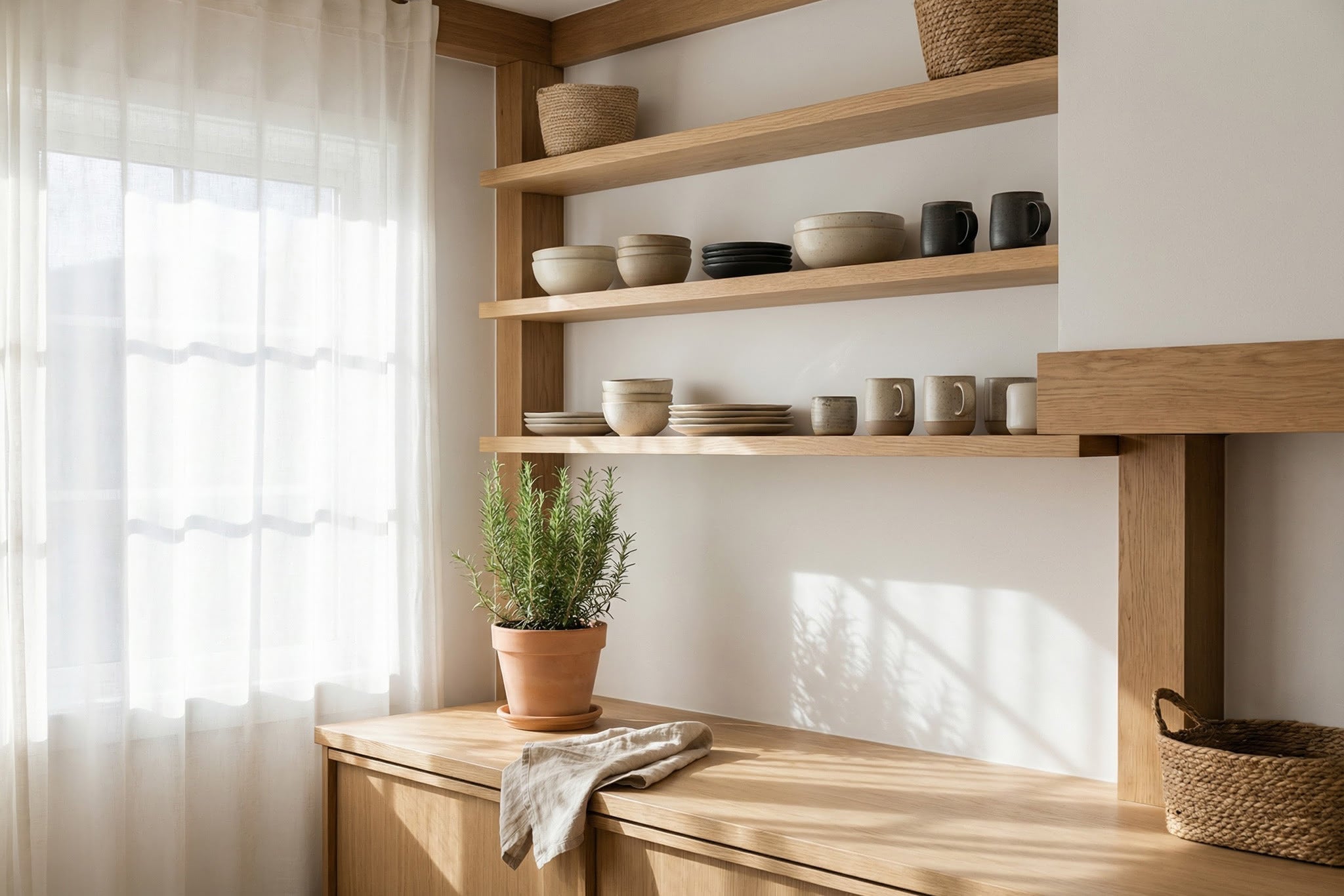
Your kitchen has twenty things on the counter right now. A japandi kitchen would have three.
That cluttered feeling you get walking into your kitchen — the mismatched containers, the appliances you haven't touched in weeks, the general chaos of a space that works hard but never looks good doing it — there's a reason it bothers you. Kitchens collect more visual noise than any other room in your home.
And the frustrating part? You've tried to organise it. You've bought storage containers and drawer dividers and that one shelf thing from Instagram. But it still doesn't feel right — because the problem was never organisation. It was intention.
That's what a japandi style kitchen gets right. Rooted in Japanese functional minimalism and Scandinavian warmth, it treats the kitchen as a space where every object earns its place — and the ones that don't, disappear. Here's how to bring that philosophy into your kitchen and dining area without a full renovation.
What Makes a Japandi Kitchen Different?
A japandi kitchen is a kitchen designed around natural materials, clean lines, and a strict "if it doesn't work, it goes" mentality — drawing equally from Japanese functional minimalism and Scandinavian warmth. It strips away the decorative excess that most kitchen trends pile on. It's not cold minimalism — it's warm, tactile, and grounded in how you actually cook and eat every day.
Japanese kitchen design values functional minimalism — hidden storage, matte finishes, surfaces cleared of anything unnecessary. Scandinavian kitchen design adds warmth through light wood tones, soft lighting, and textiles that make the space feel lived-in rather than sterile. Together, these two traditions create kitchens that photograph beautifully but — more importantly — feel calm to stand in at 7 a.m.
If you've already read the Japandi philosophy behind this design movement, you'll recognise the core principles at work here: natural materials over synthetic, restraint over accumulation, and beauty through use rather than decoration.
The Three-Object Rule for Japandi Counter Styling
Start with the counter. It's the single biggest factor in whether your kitchen feels calm or chaotic.
The japandi approach to kitchen counters follows what we call the three-object rule: leave out a maximum of three functional-beautiful items, and store everything else behind closed doors. A wooden chopping board propped against the backsplash. A ceramic vessel holding your cooking utensils. A single herb plant in a stoneware pot. That's it.
What Gets Hidden
Appliances you use less than daily — the food processor, the stand mixer, the blender — all go inside cabinets. Spices move to a drawer or cabinet near the hob, except for olive oil, salt, and pepper. Cleaning products disappear under the sink. The goal isn't to own fewer things. It's to see fewer things.
Hidden storage is non-negotiable in a japandi kitchen. Handleless cabinets with push-to-open mechanisms keep the visual lines clean. Deep drawers replace open shelving for pots, pans, and everyday crockery. If your kitchen doesn't have enough concealed storage, a simple freestanding cupboard in natural wood works — it becomes a design feature rather than a compromise.
What Earns Its Place on the Counter
Anything that stays visible needs to pass two tests: do you use it daily, and does it look good enough to be permanent decor? A well-made kettle in matte black or brushed steel qualifies. A cheap plastic toaster probably doesn't.
This is where material quality matters. In a japandi kitchen, the items on display become your styling. A hand-thrown ceramic jar, a turned wooden salt cellar, a linen tea towel draped over the oven rail — these small choices carry the entire room when there's nothing else competing for attention.
Which Materials Define a Japandi Kitchen?
Material selection is where a japandi kitchen earns its character. Unlike trend-driven kitchens that chase specific finishes (marble-effect everything, brass hardware phases), the japandi palette pulls from nature and stays there permanently. According to kitchen designers at Nordiska Kök, the enduring appeal of japandi kitchens comes from this commitment to authentic natural materials rather than manufactured trends — a philosophy that's shaped Scandinavian and Japanese kitchen design for decades.
The essential materials break down like this:
| Material | Where to Use It | Why It Works |
|---|---|---|
| Light oak or ash | Cabinets, shelving, dining table | Warm without being heavy — ages beautifully over time |
| Natural stone or concrete | Countertops, backsplash | Organic variation in every slab; matte finishes absorb light softly |
| Ceramic and stoneware | Dinnerware, display pieces, soap dishes | Handmade texture brings wabi-sabi imperfection to daily use |
| Linen | Napkins, tea towels, table runners | Softens hard surfaces; looks better rumpled than ironed |
| Bamboo or rattan | Placemats, pendant lights, small storage | Adds texture and a Japanese craft element |
Matte finishes run through everything — from cabinet fronts to tapware to the surface of your ceramic bowls. Gloss reflects light and draws attention; matte absorbs it. In a room designed for calm, that difference matters more than you'd expect.
Natural wood counters deserve a special mention. They're not the most practical choice for heavy-duty cooking (stone wins there), but as a dining surface or a breakfast bar, oiled oak or walnut brings a warmth that no engineered material replicates. The key is accepting — even welcoming — the patina that develops over months of use. That's the wabi-sabi influence at work.
Does Open Shelving Work in a Japandi Kitchen?
Yes — but only if you're disciplined about what goes on it. Open shelving is one of the most recognisable features of a japandi kitchen, and also the one most likely to go wrong. The difference between "curated and calm" and "cluttered and dusty" comes down to editing.
A single shelf or two above the worktop, displaying a considered collection of ceramic dinnerware, stoneware bowls, and one or two woven placemats, creates exactly the right effect. The objects should be things you actually use — not display-only pieces gathering dust. Stack your everyday bowls. Lean your favourite chopping board. Place your ceramic pour-over coffee maker where you reach for it each morning.
The rule: if you wouldn't photograph it, it doesn't belong on an open shelf. Everything else goes behind a cabinet door.
For the open shelving itself, natural wood in a tone that matches or gently contrasts your cabinets works best. Avoid metal brackets if you can — concealed fixings give a cleaner, floating look that suits the japandi aesthetic.
How Do You Style a Japandi Dining Room for Everyday Use?
Most dining tables in most homes serve as a dumping ground five days a week and get properly set twice a year. A japandi dining room flips that — the table should look good enough to sit at every evening, which means the everyday setting needs to be simple enough that you never clear it away. If you're looking for japandi dining room ideas that actually work on a Tuesday night (not just when guests arrive), it starts with the table setting.
Here's the everyday japandi table setting that works without any effort: woven placemats in a natural fibre (jute, cotton, or seagrass), a single stoneware bowl or plate at each place, linen napkins loosely folded, and a low centrepiece — a ceramic vessel with a single dried stem, or a wooden tray holding salt, pepper, and olive oil. That's your permanent table. It takes thirty seconds to lay and looks intentional rather than staged. The materials do the work for you — the texture of linen against stoneware against woven fibre creates visual richness without adding a single unnecessary object. If you're wondering what charger plates are and whether you need them, they can work in a japandi setting — but only in natural materials like wood or stoneware, and only if you use them daily rather than saving them for occasions.
For the table itself, solid wood is the foundation. Oak and walnut are the most common choices in japandi dining rooms — look for a simple rectangular or oval shape with slim, tapered legs. If you're considering Japandi dining tables and furniture, the test is whether the piece looks as good empty as it does set.
Dining chairs should follow the same logic: clean frames in natural wood, optionally with a linen or bouclé seat pad for comfort. Avoid anything with ornate detail or heavy upholstery — it fights the lightness the room needs.
Lighting a Japandi Kitchen: Natural First, Layered Second
Natural light is the single most important design element in a japandi kitchen — more important than your cabinets, your counters, or anything you put on them. If you can do one thing, maximise the light coming through your windows. Remove heavy curtains. Keep the windowsill clear. Let the light reach as deep into the room as possible.
After natural light, layer in three types of artificial lighting. A pendant over the dining table — paper, linen, or bamboo shades suit the japandi look far better than metal or glass. Under-cabinet strip lighting for task work at the counter. And one ambient source — a table lamp on a shelf or a wall sconce with a warm-white bulb — for evenings when you want the kitchen to feel like a room you'd linger in, not just cook in.
Skip recessed downlights if you can. They cast harsh, even light that flattens the textures and shadows japandi design depends on. A few well-placed warm sources create the depth and mood that makes the room feel alive.
The Finishing Touch: Herb Plants and Living Greenery
Every japandi kitchen needs at least one living thing. Herb plants are the obvious choice because they're functional — basil, rosemary, or mint in a simple stoneware or terracotta pot on the windowsill. You cook with them. They smell good. They look better than any decorative object because they change and grow.
If you don't have a green thumb, a single stem of dried eucalyptus or pampas grass in a ceramic vase works too. The point isn't botanical perfection — it's that organic, imperfect element that reminds the eye this is a real space, not a showroom.
Start With One Corner, Not a Full Renovation
You don't need to gut your kitchen to make it feel japandi. Start with the counter — clear it down to three objects using quality materials. Swap your placemats for woven natural fibre. Put your everyday ceramic bowls on a single open shelf. Replace one harsh overhead light with a warm pendant.
Each change takes minutes, costs very little, and shifts the room's energy immediately. The japandi kitchen isn't a style you install. It's a set of choices you make — and keep making — about what deserves space in the room where you spend the most time.
Ready to start? Browse our kitchen collection — designed for how you actually eat and live.


