



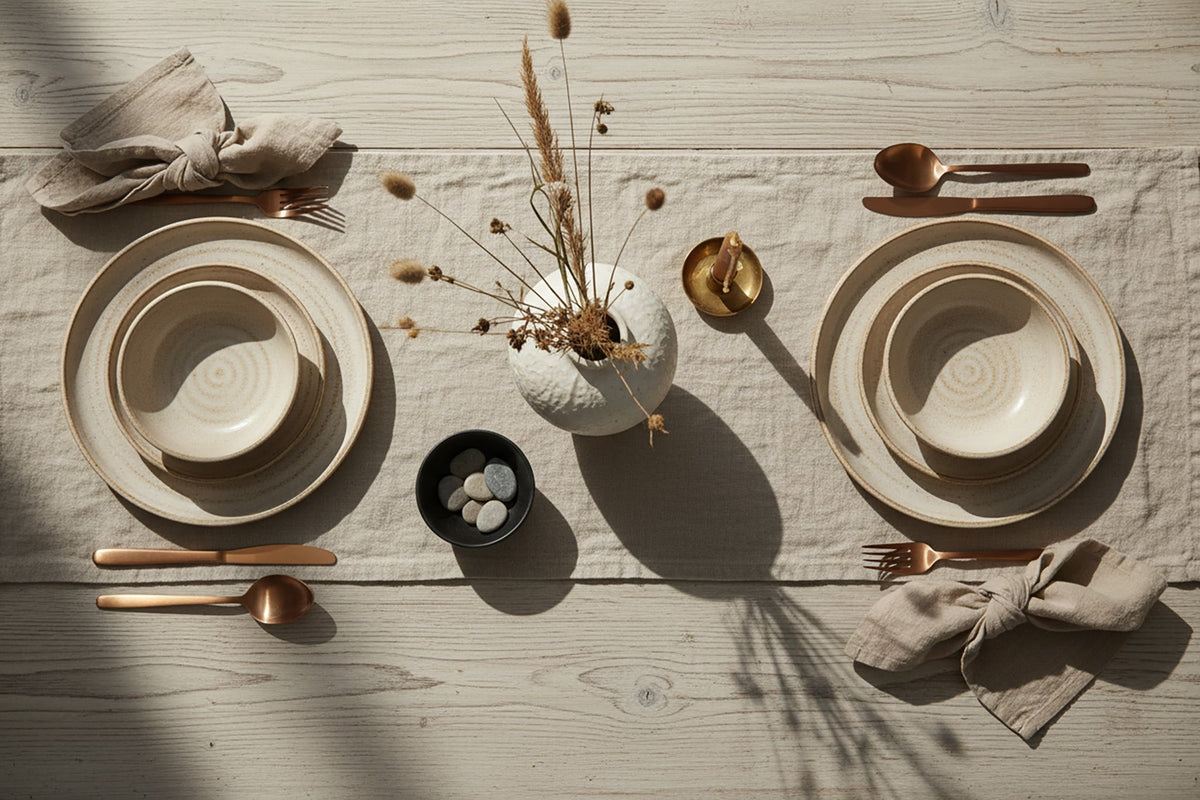
Your dining table is probably the most-used surface in your home. It shouldn't only look good when guests are coming.
Right now, your table might be a landing pad — post, keys, a laptop, yesterday's coffee mug. You know how you want it to look. You've saved the photos. But somewhere between "beautifully styled dining table" and "Tuesday night pasta," the gap feels too wide to close.
It isn't. The difference between a table that feels like an afterthought and one that feels intentional is about four things and two minutes. No etiquette guides, no matching sets, no centrepieces that take up half the table.
This is the everyday table setting guide for people who want a beautiful dining table without the fuss — the kind of setup you can do on a weeknight and still feel good about.
What Does a Good Everyday Table Setting Actually Look Like?
A well-set everyday table comes down to four elements: a plate, a napkin, a glass, and one thing in the centre. That's the foundation. Everything else — the bread plates, the charger plates, the layered runners — is optional. Most of it is unnecessary for daily meals.
The trick is quality over quantity. A single stoneware dinner plate in a warm neutral tone does more for your table than six pieces of mismatched crockery. A linen napkin folded loosely beside the plate — not fanned, not origami'd — immediately reads as considered. A simple water glass above the knife. Done.
According to a 2025 Livingetc report on table setting trends, the design world is moving away from hyper-styled, symmetrical tablescapes toward what they call "intentional imperfection" — mismatched plates, natural textures, and personal objects that tell a story. The everyday table you set for Tuesday dinner is, ironically, closer to what's considered beautiful right now than a formal twelve-piece setting.
The Two-Minute Table Setting Guide for Every Night
Here's the routine. It takes less time than boiling the kettle.
- Clear the surface. Post goes on the counter. Laptop goes elsewhere. A table with nothing on it already looks better than most.
- Set the plates. One dinner plate per person. If you're eating something that needs a bowl, place the bowl on the plate — the layering adds visual weight without extra effort.
- Add linen napkins. Fold each one in half or thirds and place it to the left of the plate. Linen holds its shape loosely, which is exactly what you want. It looks relaxed, not rigid.
- Place one glass per person. A water glass, positioned above and to the right of the plate. That's your only glassware for everyday.
- One centrepiece. A small vase with a single stem or branch. A candle in a simple holder. A small potted plant. Choose one — not three.
That's it. Five steps, under two minutes, and your table goes from "surface" to "setting."
Which Dinnerware Works Best for Everyday Tables?
Ceramic and stoneware are the best materials for everyday table settings because they're durable, microwave-safe, and naturally beautiful. Stoneware in particular has a tactile, handmade quality — slight variations in glaze and tone — that makes each plate feel like an object rather than a commodity. Earthenware offers a similar warmth but chips more easily, so it's better suited to serving dishes than daily plates. Porcelain and bone china are beautiful but feel too formal for a weeknight — save those for the meals where you're adding extra layers.
For colour, stick to warm neutrals: cream, sand, terracotta, stone grey, soft white. These tones work with any food and any table surface. If you want to introduce colour, do it through your napkins or centrepiece — not your plates. That way, you can change the mood seasonally without replacing your core set.
And yes, mismatching is fine — encouraged, even. Two plates in cream and two in sand from different makers looks intentional when the tones are in the same family. The key is keeping the palette cohesive while letting the shapes and textures vary. If you're curious about what a charger plate is and whether you need one, the short answer: not for everyday. They're a layering tool for entertaining.
Why Linen Napkins Are the Single Best Upgrade
If you change one thing about your everyday table, make it the napkins. Swapping paper for linen is the highest-impact, lowest-effort upgrade you can make. Linen napkins cost roughly the same as a month of paper napkins, they last for years, and they transform the entire feel of a meal.
A linen napkin doesn't need to be ironed. That's the beauty of the fabric — the natural creasing is part of its character. Fold it in thirds, roll it loosely, or simply lay it flat beside the plate. Each approach looks different, and all of them look good. Choose a colour that contrasts gently with your plates: if your dinnerware is cream, try a soft grey or sage green napkin. If your plates are darker, natural undyed linen works beautifully.
Practically, linen is more absorbent than cotton, dries faster, and gets softer with every wash. It's also naturally antimicrobial — a property of flax fibre confirmed by the European Confederation of Linen and Hemp — which is a genuine benefit for something that sits next to your food daily.
What Should You Put in the Centre of Your Table?
The centrepiece is where most people overcomplicate things. For everyday, you need one object — not an arrangement, not a collection, just one thing that anchors the middle of the table without getting in the way of serving dishes or conversation.
Here's what works well for everyday centrepieces, depending on the season and your mood: a single ceramic vase with one or two dried stems (eucalyptus, pampas grass, or cotton branches work year-round); a candle in a simple holder — pillar candles in natural tones or a beeswax taper; a small potted plant like a succulent or herb; or a wooden bowl with a few seasonal items (lemons in summer, pinecones in winter). A table runner underneath your centrepiece is optional but useful — it defines the centre visually and protects the table surface. Choose a natural material: linen, cotton, or jute. Keep it simple.
One rule: if your centrepiece blocks the person sitting across from you, it's too tall. For a standard dining table, keep centrepiece height under 30 cm.
The Five-Minute Upgrade When Guests Come Over
Your everyday setup is the foundation. When you're having people round, you don't need to start from scratch — you just add two or three layers on top of what's already there.
Add a bread plate
A small side plate to the upper left of the dinner plate. It gives guests a place for bread, butter, or appetisers, and it adds a visual layer that reads as "this meal is an event."
Upgrade the glassware
Add a wine glass next to the water glass. If you're serving something specific — a cocktail, a sparkling water — add a third glass. Varied glass heights create visual interest that flat table settings lack.
Double the centrepiece
Add a second candle, or place two small vases instead of one. Odd numbers look best — so if you started with one, go to three small elements rather than two. Scatter them loosely down the centre rather than clustering them.
That's your five-minute upgrade. The bones are the same as your everyday setup — you're just adding warmth and detail. For more ideas on creating that balance between minimal and inviting, see our guide to Japandi kitchen and dining room ideas.
How Do You Change Your Table with the Seasons?
Seasonal table styling doesn't mean buying new dinnerware four times a year. It means swapping one or two soft elements — your napkins, your centrepiece, or your runner — to match the mood of the season. Your plates, glasses, and cutlery stay the same year-round. That's the advantage of investing in warm neutrals: they're the backdrop, not the feature.
| Season | Napkin colour | Centrepiece idea | Mood |
|---|---|---|---|
| Spring | Soft green, blush | Small vase with fresh wildflowers | Light, airy |
| Summer | White, natural linen | Bowl of lemons or a single herb plant | Bright, effortless |
| Autumn | Terracotta, mustard | Dried flowers or a wooden candle holder | Warm, grounded |
| Winter | Charcoal, deep sage | Pillar candles or a small evergreen sprig | Cosy, intimate |
Two swaps, same plates, completely different feeling. That's the point — your everyday table should be a canvas, not a finished painting.
Your Table Deserves Better Than "Later"
A beautiful table setting isn't something you save for dinner parties. It's something you do for yourself — tonight, with whatever you already own. This entire table setting guide comes down to one idea: start with what you have. A decent plate, a cloth napkin, a glass, and one thing in the middle that you like looking at.
Once the habit sticks, you'll notice it changes how the meal feels. Not because the food is different, but because you gave the moment a frame.
Set a table that makes everyday feel considered — browse our kitchen collection.


