



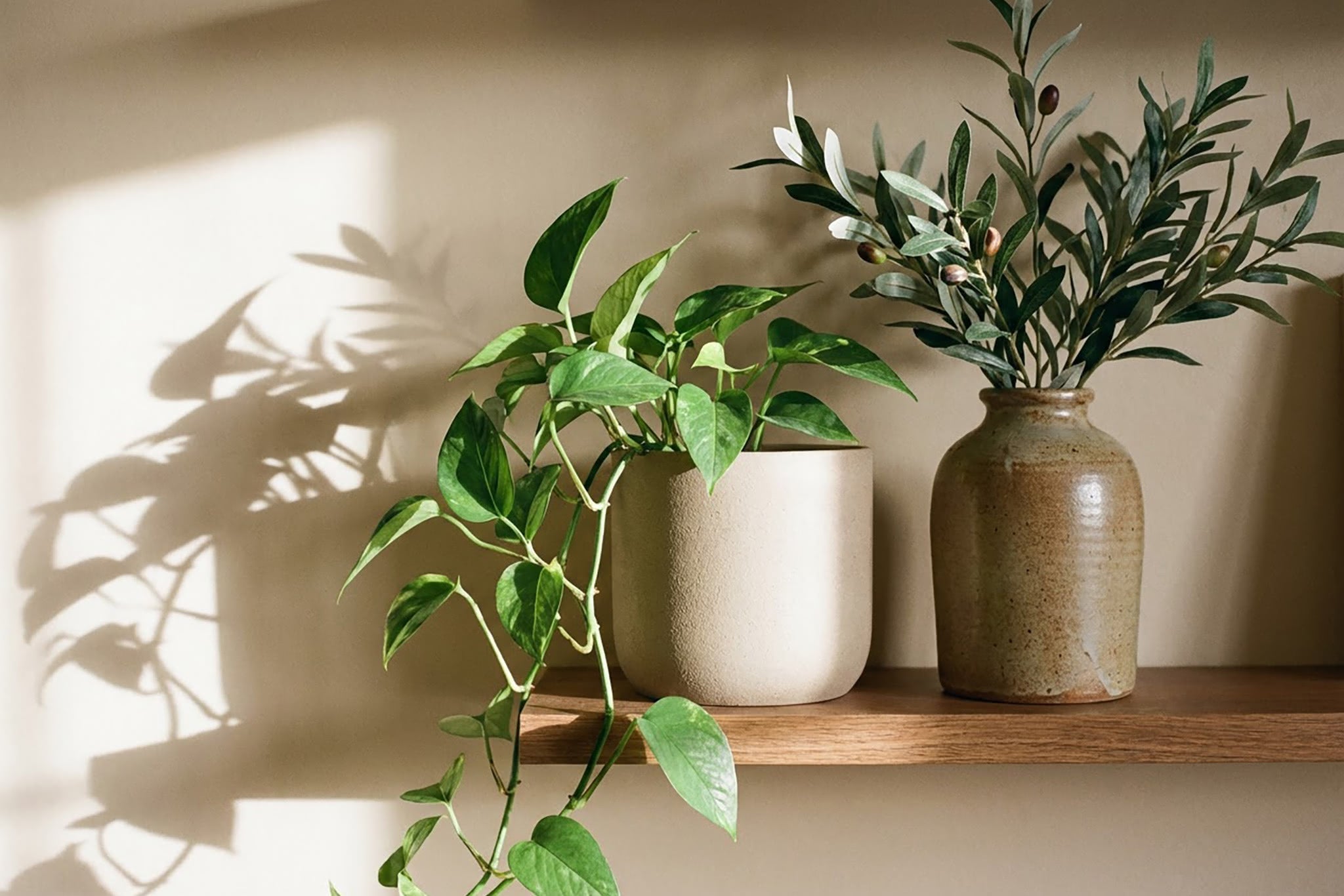
The most beautifully styled rooms you've saved on Pinterest? At least half those plants are fake. And you couldn't tell.
There's a quiet snobbery around faux plants — the idea that "real plant people" would never. But walk into any professionally styled home, showroom, or design-magazine shoot, and you'll find artificial botanicals tucked in alongside the living ones. Not as a compromise. As a choice.
The truth is, the real-vs-fake debate misses the point entirely. Knowing how to style plants in your home — whether real, faux, or a mix — comes down to shape, scale, texture, and placement. The same principles that govern every other design decision in your space.
This guide covers both. You'll learn which plants work best in each room, how to choose pots that do more for your space than the plant inside them, and how to arrange botanicals with the kind of restraint that makes a room feel calm rather than cluttered.
Why the Best-Styled Homes Mix Real and Faux
Mixing real and artificial plants isn't cheating — it's practical design. Real plants need specific light, humidity, and attention. Faux plants need none of those things. Used together, they let you put greenery exactly where it looks best, regardless of whether that corner gets four hours of sun or none at all.
According to a 2025 survey by the National Gardening Association, 67% of indoor plant owners in the US and UK now own at least one artificial plant alongside their live ones. The stigma is fading — and for good reason. Today's quality faux botanicals use real-touch materials, hand-painted leaves, and natural-looking stems that are genuinely difficult to distinguish from the real thing at arm's length. The manufacturing has moved far beyond the shiny plastic philodendrons of the early 2000s. Brands specialising in realistic faux plants — from preserved eucalyptus sprays to artificial olive trees with gnarled trunks — now produce pieces that interior designers routinely specify for high-end residential projects. The key difference is material quality: real-touch silicone leaves, wire-reinforced stems that hold natural positions, and hand-finished details like slight colour variation between leaves. When you pair these with the right pot and placement, even a seasoned plant parent would need to touch a leaf to be sure.
The strategic approach: place your real plants where conditions suit them — near windows, in humid bathrooms, on bright kitchen sills. Then fill the darker corners, high shelves, and hard-to-reach spots with carefully chosen faux pieces. The result is a home that looks lush everywhere, not just where the light happens to fall.
Which Plants Work Best for Every Room?
Not every plant belongs everywhere. The right choice depends on the room's light, humidity, and the visual role you need the plant to play — height, texture, or colour.
Living Room
Your living room can handle statement plants. A fiddle leaf fig or a tall monstera creates vertical drama and draws the eye upward, making ceilings feel higher. For Japandi living room ideas, lean toward architectural forms — a single olive tree in a matte ceramic pot beats a windowsill crowded with six small succulents.
Real options: fiddle leaf fig, monstera deliciosa, rubber plant, bird of paradise. Faux options: olive tree, tall dried pampas grass, preserved eucalyptus branches.
Bedroom
Keep bedroom plants calming and low-fuss. Snake plants are the obvious choice for a reason — they tolerate low light, barely need watering, and their upright form suits a nightstand or a narrow corner. A trailing pothos on a high shelf adds softness without taking up floor space.
Real options: snake plant, pothos, ZZ plant, peace lily. Faux options: dried lavender bundle, preserved moss in a shallow bowl, a single faux branch in a bud vase.
Bathroom
Bathrooms are where real plants genuinely thrive — most tropical houseplants love the humidity. A Boston fern on a shelf or a small pothos trailing from a high window ledge makes a bathroom feel like a spa without any effort.
Real options: Boston fern, air plants, pothos, calathea. Faux options: preserved eucalyptus (hung from the showerhead, it looks incredible), faux trailing ivy for windowless powder rooms.
Kitchen
Kitchens suit herbs and compact greenery. A few pots of fresh basil, rosemary, or thyme on the windowsill serve double duty — they look good and you can cook with them. For spots away from the window, a small faux herb arrangement in a ceramic pot adds the same visual warmth.
Entryway
Entryways often lack natural light, which makes them ideal for high-quality faux plants. A tall faux olive tree or a curated botanical arrangement sets the tone for the rest of your home — pair it with the right console or bench for a complete entryway styling moment. Keep it structural — one strong piece rather than a cluster of small pots.
Why Does the Pot Matter More Than the Plant?
Here's something stylists know that most people don't: in our experience, the pot determines the majority of how a plant reads in a space. A gorgeous fiddle leaf fig in a plastic nursery pot still looks unfinished. A basic fern in a handmade stoneware vessel looks like an intentional design moment.
Pot selection is where Japandi principles apply most directly to plant styling. The Japanese aesthetic values the vessel as much as what it holds — in ikebana, the container is considered part of the arrangement, not just a holder for it. Scandinavian design adds the principle of functional beauty: the pot should be well-made, pleasant to touch, and proportioned to its surroundings. Together, these philosophies suggest choosing pots made from natural materials — stoneware, terracotta, concrete, or ceramic in matte finishes and earthy tones. Avoid anything glossy, plasticky, or heavily patterned. The pot should complement the plant's natural form, not compete with it. A general rule: the pot's diameter should be roughly one-third to one-half the width of the plant's canopy. Too small and the plant looks top-heavy. Too large and the whole arrangement loses its sense of proportion. For tall, narrow plants like snake plants, a cylindrical pot with clean lines works best. For trailing plants, a wider, shallower bowl lets the foliage cascade naturally over the rim.
One more thing: for faux plants, the pot is even more important. It's the detail that sells the illusion. Add a layer of real soil, moss, or river pebbles on top to hide the foam base — this small touch makes an enormous difference.
How Do You Arrange Plants Without Cluttering a Room?
The biggest mistake in plant styling is overcrowding. More plants don't automatically make a room feel greener — they make it feel busy. The goal is intentional placement: each plant should have a clear role in the room's composition.
Borrow from ikebana, the Japanese art of flower arrangement. In ikebana, three elements are enough — one tall, one medium, one short — arranged asymmetrically to create visual movement. You don't need a jungle. You need three well-placed plants that create a sense of rhythm.
Apply this to your home: choose one statement plant per room (the tall element), one mid-height piece for a shelf or side table (the medium), and one small botanical for a nightstand or coffee table (the short). Vary the textures — pair a broad-leafed monstera with a wispy dried grass and a compact succulent. The variety keeps the arrangement interesting without the visual noise of twelve identical pots.
Spacing matters too. Leave breathing room between plants. In Japandi interiors, negative space is as important as the objects themselves — the empty space around a plant is what gives it presence. A single olive branch in a ceramic vase on an otherwise clear console table will always look more considered than a crowded shelf of small pots.
Plant stands are another useful tool. A mid-height plant stand lifts a floor plant to eye level and creates vertical layering without adding visual weight. Choose one in a natural material — wood, rattan, or black metal — that complements the pot rather than competing with it.
How to Make Faux Plants Look Convincingly Real
Even high-quality faux plants can look artificial if you don't style them properly. These five adjustments take about two minutes and make all the difference.
Bend the stems. Faux plants arrive with every stem perfectly straight and evenly spaced — which is exactly how you spot a fake. Gently bend the wire-reinforced stems outward at different angles. Rotate some leaves to face slightly different directions. Real plants don't grow in perfect symmetry, and your faux ones shouldn't either.
Repot immediately. Never display a faux plant in its original plastic pot. Transfer it to a ceramic, stoneware, or terracotta vessel. This one change does more for realism than any other.
Top with natural materials. Cover the foam base with real soil, preserved moss, small river stones, or dried bark. This hides the artificial base and adds a layer of texture that reads as genuine.
Place them where real plants would grow. Even though faux plants don't need sunlight, positioning them near a window or in a well-lit corner tricks the eye. A faux fern in a dark hallway looks staged. The same fern near a window with filtered light looks real.
Dust them. Real plants don't accumulate thick layers of dust (rain and air movement keep them clean). Wipe faux leaves with a damp cloth every few weeks. It sounds obvious, but dusty leaves are the fastest way to reveal that a plant is artificial.
The Best Low-Maintenance Real Plants if You're Just Starting Out
Not ready to commit to a fiddle leaf fig? These five plants are genuinely difficult to kill, and they all look beautiful in a well-styled vignette.
| Plant | Light Needs | Watering | Best For |
|---|---|---|---|
| Snake plant | Low to bright indirect | Every 2–3 weeks | Bedrooms, bathrooms, offices |
| Pothos | Low to medium indirect | When soil is dry | Shelves, hanging planters |
| ZZ plant | Low to bright indirect | Every 2–4 weeks | Entryways, dark corners |
| Rubber plant | Medium to bright indirect | Weekly in summer | Living rooms, statement corners |
| Air plants | Bright indirect | Mist 2–3 times/week | Bathrooms, small shelves |
All five tolerate neglect, bounce back from missed waterings, and suit the clean lines and natural palette of a Japandi-inspired interior. Start with one or two and build from there — the "buy less, buy better" philosophy applies to plants as much as it does to anything else in your home.
Style With Intention, Not Volume
Learning how to style plants in your home — whether real, faux, or a mix of both — isn't about recreating a greenhouse. It's about adding life, texture, and a connection to the natural world in a way that feels effortless and considered.
Pick one room. Choose one plant — real or faux — that suits the space. Put it in a beautiful pot. Place it with intention. Stand back and notice how much that single, well-chosen piece changes the feeling of the room.
That's plant styling. Not more. Just better.
If you're looking for faux botanicals that look the part, browse our botanical collection — every piece is hand-selected for realism and style.


